


Josh McInnes
Co-Founder, Director of Cetacean Research
Josh McInnes is a marine ecologist with expertise in the foraging ecology, social behavior, and habitat use of marine mammals. He holds a Master of Science (MSc) in Oceans and Fisheries from the University of British Columbia (UBC) and a Bachelor of Science (BSc) in Biology from the University of Victoria (UVic).
With over 25 years of field experience, Josh has become a leading authority on transient (mammal-eating) killer whales along the Pacific coast, from Southeast Alaska to Southern California. His current research focuses on the feeding behavior, population dynamics, social structuring, and habitat use of these apex predators within the California Current System.
In addition to his work on killer whales, Josh also studies the behavior and ecology of a number of toothed cetaceans, including Risso’s dolphins, Pacific white-sided dolphins, common dolphins, northern right whale dolphins, and sperm whales contributing to a broader understanding of predator-prey dynamics and the structure of marine mammal communities in this ecologically rich region.
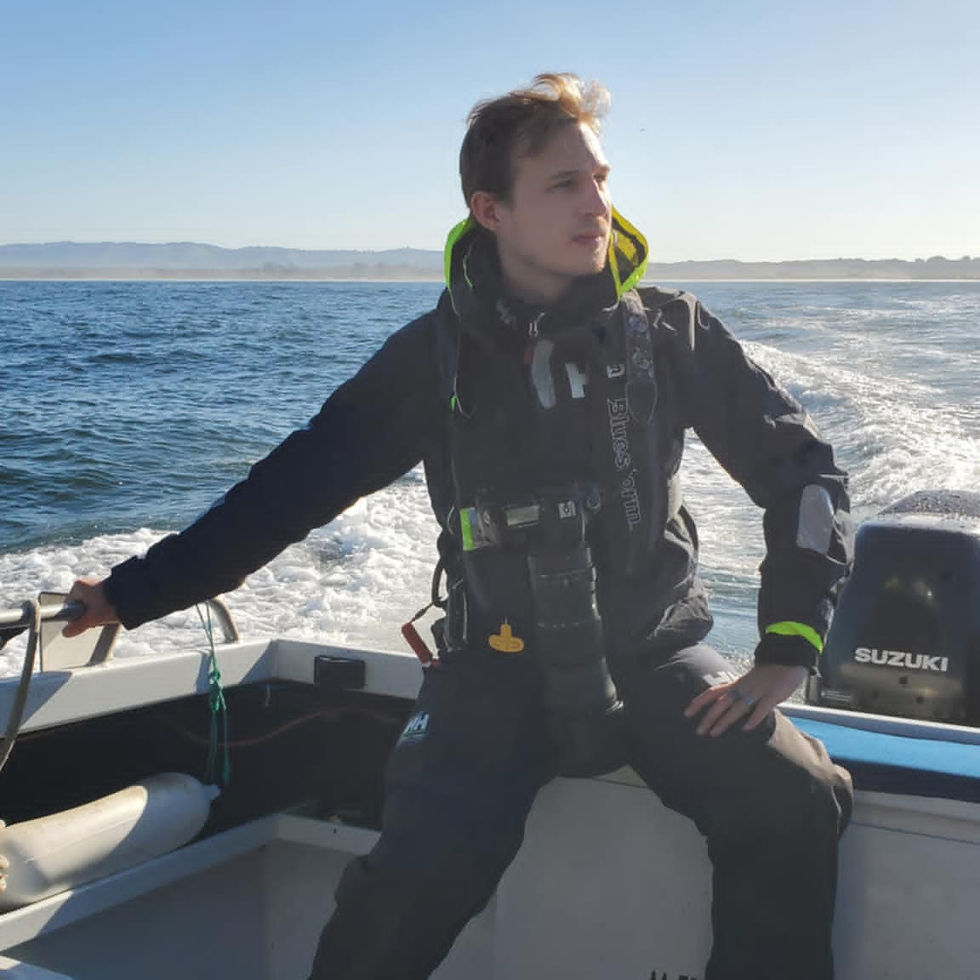
Kevin Lester
Co-Founder, GIS Specialist, Director of Seabird Conservation
Born and raised in Olympia, Washington, Kevin Lester brings a unique blend of artistic vision and scientific expertise to marine conservation. He studied Studio Arts at Pacific Lutheran University before earning a Master’s degree in Environmental Studies from The Evergreen State College, where he specialized in advanced GIS applications in marine environments.
Kevin’s passion for spatial ecology began on the waters of Puget Sound, where he spent a dedicated year independently mapping marine mammals from a small research vessel. Following his graduate work, he contributed to a range of high-profile international GIS projects, including a global wolf distribution model with the National Geographic Society and large-scale reforestation initiatives in Borneo and Uganda with Fairventures Worldwide. He also served as a GIS resource for Washington Tribes at the Northwest Indian Fisheries Commission, supporting Indigenous stewardship and fisheries management.
Today, Kevin applies his GIS expertise to cetacean research. He is also actively engaged in exposing the environmental impacts of industrial fisheries along the British Columbia coast through his work with Pacific Wild.
With a career rooted in both conservation and cartography, Kevin continues to advance the role of spatial science in marine protection and ecological storytelling.

Chelsea Mathieson
Marine Conservation Director, Environmental Scientist
Chelsea Mathieson is an environmental scientist and marine conservation planner with over a decade of experience studying killer whales and working to protect coastal ecosystems. Originally from the Kootenays in British Columbia, she has called Vancouver Island home for more than 10 years—where her passion for the ocean and marine wildlife.
Chelsea holds a Master’s degree in Resource and Environmental Management and Planning (MRM) from Simon Fraser University, a Bachelor of Science (BSc) in Environmental Science from Royal Roads University, and a diploma in Integrated Environmental Planning Technology from Selkirk College. Her academic and professional focus has centered on marine conservation planning, with a strong commitment to the protection and sustainable management of marine habitats.
Currently, Chelsea works in collaboration with Coast Salish Nations on marine resource planning, supporting Indigenous-led stewardship and long-term conservation strategies. She is especially passionate about advancing marine protected areas and National Marine Sanctuary designations as tools for safeguarding marine biodiversity and ecosystem health.
Chelsea’s favorite cetacean is the northern right whale dolphin, a species whose elusive nature reflects her deep appreciation for the lesser-known inhabitants of the Pacific. Through her leadership and collaborative work, Chelsea continues to promote a vision of conservation rooted in respect, science, and community.

Dr. Larry Dill
Senior Scientist, Behavioral Ecologist
Dr. Larry Dill is a behavioral ecologist renowned for his pioneering work on how animals make adaptive decisions in response to ecological trade-offs. His research examines the cost-benefit dynamics underlying key behaviors such as foraging, predator avoidance, and reproduction, all through the lens of maximizing individual fitness.
A seminal figure in marine mammal behavioral ecology, Larry—alongside Dr. Robin Baird—was among the first to study the behavioral ecology of transient (mammal-eating) killer whales off Southern Vancouver Island. Their early research helped establish foundational understanding of how these apex predators hunt, socialize, and partition habitat, setting the stage for decades of subsequent killer whale research in the Pacific Northwest.
.jpg)
Dr. Andrew Trites
Senior Marine Mammal Scientist
Andrew's research is primarily focussed on pinnipeds (Steller sea lions, northern fur seals, and harbor seals) and involves captive studies, field studies and simulation models that range from single species to whole ecosystems. His research is designed to further the conservation and understanding of marine mammals, and resolve conflicts between people and marine mammals.
In addition to his research at ORA, Andrew oversees a research program that includes researchers, students, technicians and support staff at the Marine Mammal Research Unit at the University of British Columbia's Institute for the Oceans and Fisheries . The training of students, and the collaboration between researchers specializing in other disciplines (such as nutrition, ecology, physiology and oceanography) is central to the success of his research program.

Sophie Darling
Marine Biologist, Scientific Illustrator
Sophie Darling has worked in the marine mammal field since 2006, beginning her career with California sea lions while earning her Bachelor of Science in Marine Biology from the University of California, Santa Cruz. Over the following 16 years, she built deep expertise in marine mammal behavior, wildlife education, and community-based conservation.
In 2022, Sophie completed her Master of Arts in Biology with a focus on conservation at Miami University. Her graduate research explored burnout prevention in the conservation and wildlife care community, with a particular interest in the role of nature in fostering resilience and well-being.
Sophie’s journey in marine biology has brought her back to Monterey, California, where she now serves as both a naturalist and general manager at Discovery Whale Watch. She is passionate about using ecotourism as a platform for education and conservation, inspiring action by helping passengers form meaningful connections with the ocean.
Outside of her fieldwork, Sophie expresses her love for the natural world through scientific illustration. Her artwork supports conservation organizations and projects around the world, including logo design for the Ocean Research Alliance and contributing illustrations to a guidebook for the Estero Hondo Marine Mammal Sanctuary in the Dominican Republic.

Michelle Watt
Southern Resident Killer Whale Outreach Coordinator
Born and raised on unceded W̱SÁNEĆ and lək̓ʷəŋən territories, Michelle Watt is a conservationist whose work and studies are focused on the restoration ecology of Vancouver Island’s terrestrial and aquatic ecosystems.
For more than 20 years Michelle has participated in efforts to restore salmonid populations and enhance habitat in the region’s urban waterways. She leads and participates in various ecological restoration initiatives across South Vancouver Island, working with communities to build meaningful connections with local ecosystems in order to sustain and protect biodiversity.
For over a decade, her work has focused on the recovery of Southern Resident Killer Whales — combining public education, engagement, and art-based initiatives with political advocacy at multiple levels of government in order to drive meaningful, evidence-based conservation actions.
With a background in visual communication, Michelle integrates photography, videography, and illustration into her conservation work, using art as a powerful tool for environmental education and advocacy.

Danny Frank
Marine Operations Coordinator / Captain
Danny Frank is a seasoned mariner with years of experience operating vessels off the central coast of California. Born and raised in Fort Ord, Danny has spent over 30 years on the water, operating vessels and guiding passengers through the rich marine ecosystems of the California coast.
With decades of experience navigating the waters around whales, Danny brings exceptional skill in vessel operations, drone piloting, and marine photography. His favorite marine mammal, the elusive Baird’s beaked whale, reflects his deep appreciation for the lesser-known species of the Pacific.
Danny is widely respected for his calm leadership, technical expertise, and ability to spot and interpret marine wildlife behavior in real time. Whether deploying drones to document whale behavior or ensuring smooth day-to-day operations on Fisherman’s Wharf, he plays a pivotal role in maintaining the safety, professionalism, and educational focus of Discovery Whale Watch.
Combining his passion for marine life with a lifetime of seafaring experience, Danny continues to inspire guests and staff alike—offering not just unforgettable wildlife encounters, but a deeper understanding of the ocean and its inhabitants.

Trevor Schroeter
Fisheries Liaison Officer
Trevor Schroeter is a lifelong fisherman and dedicated conservationist with over 15 years of experience working in recreational and commercial fisheries throughout the nearshore and offshore waters of the northeastern Pacific. Passionate about ocean science, Trevor actively tracks marine mammal sightings and contributes regularly to research on ocean ecosystem dynamics.
Spending much of his time offshore, Trevor has a particular interest in transient killer whale populations that range beyond the continental shelf. When not at sea, he brings a unique blend of skills as a seasoned software engineer, avid mushroom forager, and coastal river angler. He also volunteers at local hatcheries, supporting fish conservation and community engagement.
In addition to his field work, Trevor serves on the Government Relations Committee for the Coastal Conservation Association of Oregon, where he monitors and advises on fisheries-related policies and litigation at both state and federal levels.

Ryan Hou
Field Data Collection Specialist
Ryan Hou grew up in Windsor, Ontario, where his early years were spent navigating and fishing the waters of Lake Erie. His deep-rooted connection to freshwater ecosystems, combined with a lifelong fascination with wildlife—and a little encouragement from his wife—led him across the country to pursue a degree in Marine Biology at the University of Victoria.
During and after his studies, Ryan immersed himself in the ecotourism industry, gaining extensive sea time as a deckhand aboard vessels up to 500 gross tons. Driven to elevate his maritime career, he earned his 60-ton Master Captain’s license and soon after founded Neptune Wildlife Tours in Sooke, British Columbia.
With years of experience exploring the dynamic waters of the Juan de Fuca Strait, Ryan brings expert-level navigational skills, a strong working knowledge of local marine ecosystems, and advanced identification skills of species such as humpback and killer whales.
Ryan and his business are highly respected in the region for promoting responsible whale watching and fostering meaningful connections between travelers and the marine environment. He believes that sparking curiosity and wonder in others is key to supporting conservation and research efforts.
Fun fact: Before diving full-time into whale watching, Ryan spent years working in fine-dining restaurants—if he wasn’t guiding on the water, he says he’d likely be a chef.
Favorite marine mammals: Killer whales top the list, but northern elephant seals come in a close second.

Sher Stedman
Development Coordinator
Sher is a communications professional and emerging writer with a background in fundraising and program development for non-profit organizations. A lifelong fascination with whales and dolphins inspired her deep connection to the ocean, which further solidified after earning her first scuba certification while living in Australia.
She later pursued a degree in Fundraising Management from Toronto Metropolitan University, where she discovered a passion for purposeful storytelling and advocacy. Now based on the West Coast, Sher dedicates her voice to ocean conservation, using narrative to support the protection of the Salish Sea and the communities and species that depend on it. Through the Oceanic Research Alliance, she combines her writing, outreach, and fundraising skills to elevate marine conservation initiatives and engage the public in stewardship.
Staff

Mat Arcoleo
Board Member
Mathew Arcoleo brings together a rich family legacy and decades of experience in high-tech leadership. Although he spent nearly 30 years building a successful career in the semiconductor industry in the San Francisco Bay Area, his roots have always remained in Monterey—particularly on the historic Fisherman’s Wharf.
Mathew’s connection to the wharf runs deep. His great-grandfather launched the first sport fishing operation there, and both his grandfather and father owned and operated Frank’s Fishing Trips. As a child, Mathew was known affectionately as a “wharf rat,” often found in his father’s shop or working as a deckhand on the boats.
After graduating from Monterey Peninsula College, Mathew went on to earn a bachelor’s degree in electrical engineering from San Jose State University and an MBA from Santa Clara University. Despite his success in the tech world, he always felt drawn back to the ocean and the community that shaped his early years.
That calling became a reality when the opportunity arose to purchase Randy’s Fishing Trips & Whale Watching. Mathew saw it as a chance to return to his roots and carry forward his family’s maritime tradition. Today, he proudly operates one of the most iconic whale watching and fishing companies on Fisherman’s Wharf, Discovery Whale Watch, which blends his lifelong passion for the sea with a commitment to sustainable ecotourism and community engagement.

Ron Rogers
Board Member
Ron was born in Southern California and spent his early years moving across regions of the West Coast and northern Canada, developing a lifelong connection to animals and the outdoors. His experience caring for and working alongside animals ranged from domestic species to large carnivores, deepening his respect for wildlife and the responsibility that comes with interacting with it.
Ron began operating boats as a teenager in Ventura, California, where he discovered his comfort and confidence on the water. In 1994, he began managing a horse ranch, a role he held for nearly two decades—and where he met Jane Mayer. The two quickly formed a partnership grounded in shared values of care, curiosity, and adventure.
Jane often spoke about her dream of spending time on Monterey Bay, and in 2015, that dream became reality when they acquired their vessel and began exploring the bay together. Those first trips introduced them to a thriving community of naturalists, captains, and researchers, as well as unforgettable encounters with whales, dolphins, and seabirds. A chance meeting with Josh during a killer whale lecture opened the door to deeper involvement in research and stewardship efforts—relationships that continue to shape their work on the water today.
Ron now contributes his seamanship, local knowledge, and steady presence to support marine wildlife observation and collaborative research throughout the Monterey Bay region.

Jane Mayer
Board Member
Originally from Scotland, Jane moved to California in 1975 and built a career working closely with animals as a veterinary technician in Watsonville. Her lifelong commitment to animal care fostered a deep respect for wildlife and the natural world.
In 2015, Jane and her husband Ron set their sights on spending more time on the Monterey Bay, leading them to acquire their research vessel and begin regular outings on the water. They happened to begin their boating journey during one of the most wildlife-rich years in recent memory, sparking a passion for observing and learning from the bay’s marine life. Their time on the water soon became a twice-weekly practice of quiet observation, natural history, and stewardship.
Connecting with Josh, Chelsea, and later Kevin deepened their knowledge and involvement in regional marine research efforts. These relationships have become both collaborative and personal, shaping a sense of family grounded in shared curiosity, respect for wildlife, and care for the living waters of the California Current.